
What Is Liu Jin (Flowing Gold) Lacquer? Inside the 13-Step Proces

Updated: Sep 27
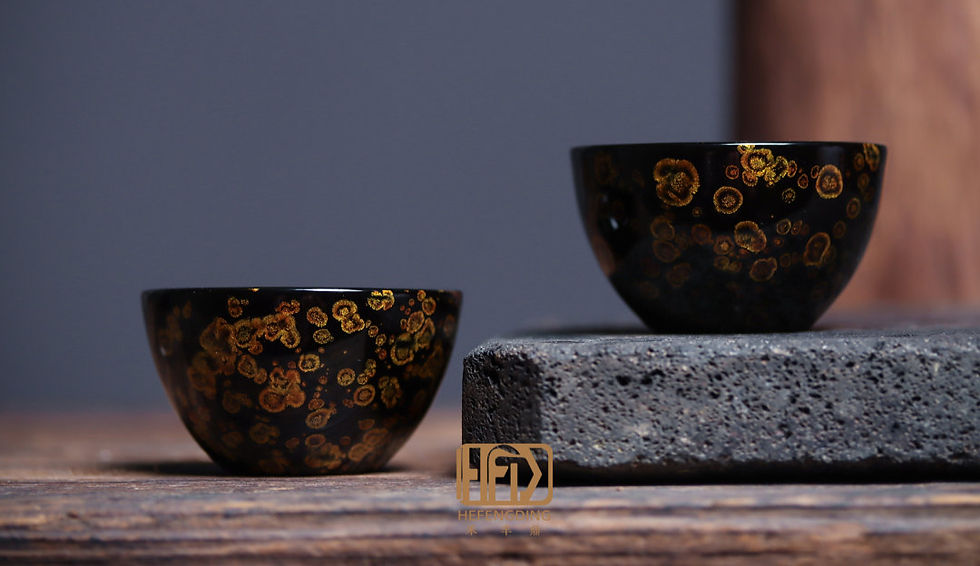
Liu Jin (流金, "Flowing Gold") is a contemporary Chinese lacquer technique in which gold lacquer is dripped onto a lacquered surface by rhythmically tapping a loaded brush, letting the drops land and spread into fluid, abstract patterns like molten gold. Because every drop falls and flows on its own, no two pieces are ever alike.
The process begins long before the gold. The wooden core is first sealed and stabilized, then built up with ten coats of natural lacquer. Only then is the gold applied. Once it has cured slowly in a humid, shaded room, the piece is covered in clear lacquer, sanded back, and finally wiped and hand-polished to a deep, glowing finish.
Much like traditional Chinese lacquer painting, which evolved from decorative furniture accents into standalone fine art, Liu Jin takes ancient techniques and elevates them into dynamic, abstract aesthetic expression. Yet its creation remains rooted in classical raw lacquer (生漆, known in Japan as urushi) traditions. Below is a step-by-step look at the 13 painstaking stages required to bring a single Liu Jin piece to life.
Phase 1: Building a Durable Foundation (Steps 1–6)
Before any artistic decoration begins, months of foundational work are required to ensure the piece will remain structurally sound for generations.
1) Sanding the Substrate (Tai Ti / 胎体打磨)
The craftsman light-sands the base object (wood, bamboo, or cloth) to smooth out natural surface irregularities. Any minor dents or gaps are filled with natural lacquer putty and sanded flat.
2) First Coat of Raw Lacquer (擦生漆)
A layer of pure, unmixed natural raw lacquer is wiped across the raw substrate, allowing it to penetrate deeply into the grain. This creates a strong bond between the base material and all subsequent layers.
3) Ash Grounding (Gua Hui / 挂灰)
A mixture of fine mineral powder (tile ash) and raw lacquer is applied evenly over the base using a grounding blade to fill microscopic pores. This step stabilizes natural materials like wood, preventing warping or cracking caused by changes in temperature and humidity. Grounding is typically applied in three progressively finer layers (coarse, medium, and fine ash).
4) Reinforcing Coat (擦生漆)
After each grounding layer dries in a temperature-controlled curing chamber, the surface is sanded and coated again with 100% pure raw lacquer to lock in structural integrity.
5) Cloth-Backing (Pi Ma Gua Hui / 披麻挂灰)
To add maximum durability, fine linen or hemp cloth is wrapped around the object and secured with lacquer ash. The full cycle—applying cloth, grounding, drying, sanding, and re-wiping with raw lacquer—is repeated up to three times.
6) Final Seal of the Foundation (擦生漆)
A final coat of raw lacquer seals the cloth-backing and grounding phase. The structural foundation is now complete.


Phase 2: Building the Lacquer Body (Steps 7–9)
With the foundation set, the craftsman begins building the depth and body of the piece.
7) Layering the Lacquer (Xiu Qi / 髹漆)
The object is built up through four successive coats of lacquer. Each individual layer requires days to cure in a warm, humid chamber before the next can be applied.
8) Intermediate Sanding (打磨)
Although raw lacquer is meticulously filtered before each use, microscopic dust particles are inevitable. After the fourth layer, the surface is carefully hand-sanded smooth.
9) Deep Body Curing (髹漆)
The craftsman continues building up the lacquer body layer by layer. In our studio, we typically build up 10 or more solid coats of lacquer before moving to the artistic stage.

Phase 3: The Art of "Liu Jin" (Steps 10–11)
This is the signature moment where raw lacquer meets artistic expression.
10) The Clear Lacquer Base (髹透明漆)
Before applying gold, a fresh layer of clear (transparent) natural lacquer is spread across the surface. This fluid base allows the gold to spread and flow naturally. Without this wet base, the gold would remain static, resulting in a flat and lifeless appearance.
11) Creating Flowing Gold (Liu Jin / 流金)
High-purity gold powder is thoroughly blended with raw lacquer to form a rich gold-lacquer mixture. Using custom tools, the artisan drips, pours, or scatters the gold lacquer across the piece. The liquid gold drifts like running water, falling rain, or a cascading waterfall—striking a perfect harmony between natural spontaneity and artistic control.


Phase 4: Encapsulation & Hand-Polishing (Steps 12–13)
The final phase protects the gold design while revealing its inner luster.
12) Double Clear Lacquer Encapsulation (髹透明漆)
Two additional layers of clear lacquer are applied over the gold pattern to protect it:
First clear coat: Cured, then sanded with 2000-grit sandpaper to level out tiny surface textures.
Second clear coat: Cured, then progressively wet-sanded with 3000-grit, 5000-grit, and 7000-grit sandpaper until ultra-smooth.
13) High-Gloss Hand Polishing (Kai Qing Tui Guang / 揩清推光)
The ultimate signature of fine lacquerware. The artisan applies specialized oil-and-powder polishes by hand, repeating the wiping and rubbing cycle 6 to 7 times. This process brings out a deep, warm, and understated luster that synthetic finishes can never replicate.

Experience the Heritage of Natural Lacquerware
Every Liu Jin creation is a devotion to time, requiring 4 to 5 months of dedicated handcrafting and natural curing.
Explore Our Collection: Discover our unique selection of handcrafted Lacquerware Tea Accessories, & Fine Living.
Bespoke Custom Orders: Looking for a tailor-made lacquerware piece or custom artwork for your space? Contact us today to discuss your bespoke order!


Comments