
What Is Xipi Lacquer (Rhino-Skin Lacquer)

Updated: 4 hours ago
Xipi lacquer, also known as rhino-skin lacquer, is a decorative technique used in Chinese lacquerware. Its distinctive patterns are created by building raised mounds, applying layers of colored lacquer, and polishing the surface to reveal the layers beneath. At HFDlacquerware, we use natural lacquer to create each piece by hand.
The texture of Xipi lacquer isn’t painted on, and it isn’t carved.
It’s built—mound by mound.
How Is the Xipi Lacquer Pattern Created?
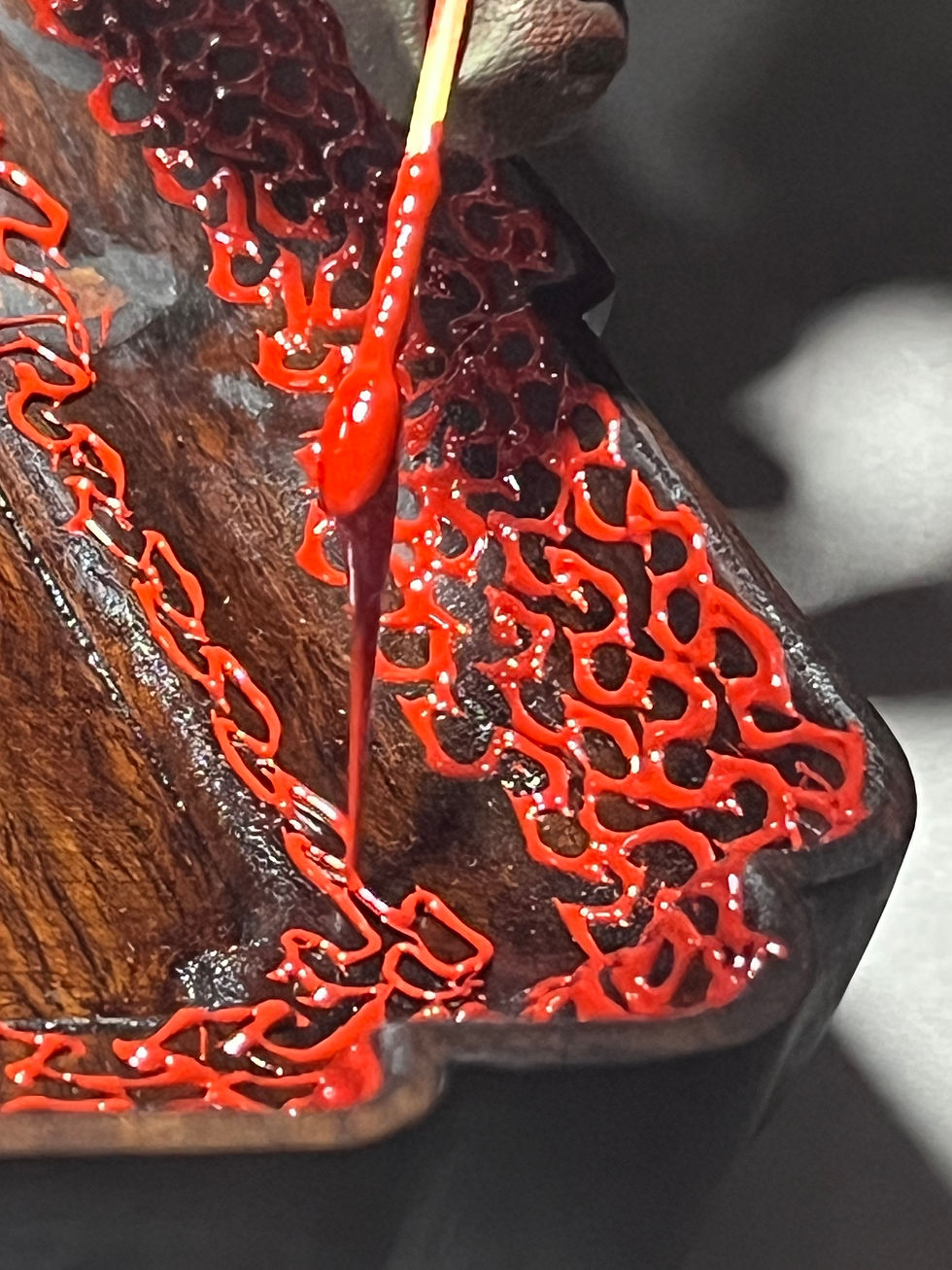
One small mound rises beside another. Each is left to dry, then lacquered, dried again, lacquered again — over and over. Layer by layer, the lacquer slowly rises until it levels with the mounds beneath it, burying the once-uneven surface completely from view. Only then does the polishing begin. The lacquer is worn away, little by little, until the hidden peaks and valleys, colors and layers, slowly come back into view.
So the pattern you finally see in Xipi lacquer was decided long before, back when the mounds were first built. It simply couldn't be seen — not until the polishing revealed it.
No two pieces of Xipi lacquer are alike. Different mounding techniques, different lacquer thicknesses — the height and spacing of the mounds, how connected they are, how many layers of lacquer were applied — all of it shapes a different pattern in the end.


One Scholar's View of Xipi Lacquer
Lacquerware researcher Yuan Quanyou, in her essay On Xipi Lacquerware (Wenwu Cankao Ziliao, Issue 7, 1957), described Xipi lacquer this way: the surface is smooth, its patterns formed from layers of differently colored lacquer — sometimes flowing like drifting clouds and water, sometimes ridged like the bark of a pine tree. At first glance the pattern seems even and regular; look closer, and it reveals endless variation, following no fixed rule, moving as if alive, brilliant in color.
HFD’s Chong and Yi Series: What Is the Difference?
Because Xipi lacquer's texture can vary so widely, we divide it into two series: Chong and Yi.
Chong comes from the I Ching: "To know the heights, yet hold to humility — Chong takes after Heaven, and the low takes after Earth." Chong means the high, the lofty — like the sky above.
Yi comes from the Tao Te Ching: "The great Way is smooth and easy, yet people love the shortcuts." Yi means the level, the natural — like the Way itself.
The two names reflect two different ways we understand Xipi lacquer.
The Chong Series uses tall mounding — the peaks rise higher and more dramatically. After many rounds of lacquering and polishing, the resulting pattern shows more distinct layers and a stronger sense of depth.
The Yi Series uses low mounding — it doesn't chase height or contrast, but instead lets the natural flow of the pattern take center stage.
The two series don't differ in process — only in how the mounds are built.
For Chong, each mound is built one at a time with a toothpick. It sounds like a humble tool, but the work depends entirely on a steady hand and patience — the smallest inconsistency changes the final sense of depth.
For Yi, lacquer is dabbed on with a loofah vine in a rhythmic tapping motion, raising small, rolling hills one after another.
Same mounding, different hands, different rhythms — and in the end, different patterns emerge from the polishing.

Why Does Every Piece of Xipi Lacquer Look Different?
Our lacquer artisans say that making Xipi lacquer always holds surprises — and occasionally, shocks. It's a craft that feels alive. The process itself is repetitive, even tedious: mound by mound, coat after coat of lacquer, drying, and starting again. What everyone waits for is the moment of polishing.
While mounding, you have a rough sense of how the layers will look. While lacquering, you have a rough sense of how the depth will feel. But exactly how it will finally appear — no one can say for certain. Only after polishing do you know the answer.
Every piece carries its own anticipation. Every shift in mounding technique can bring a different result — like revealing a hidden treasure. You never fully know what's inside until you open it. That's why, however repetitive the process, no two pieces of Xipi lacquer are ever truly the same.

Curious what Chong and Yi actually look like, side by side? A glance often says more than words — you'll find both on our homepage.


Comments