
What Is Raw Lacquer? Understanding Chinese Lacquerware Through a Single Drop

If you want to understand traditional Chinese lacquerware, there is one material you must get to know first: raw lacquer.
The first time most people see raw lacquer, it looks nothing like what they expect. It isn't black, nor is it deep crimson.
Freshly tapped from the lacquer tree (Toxicodendron vernicifluum), raw lacquer is actually a thick, milky-white resin. The moment it encounters the air, a transformation begins. Its hue shifts gradually—from pale rose to warm reddish-brown, deepening into rich chestnut, and eventually reaching dark, earthy tones.
Within just a few hours, a delicate film settles over its surface. Yet, this is merely the beginning.
When raw lacquer is applied to an object and left to cure slowly under strict temperature and humidity conditions, its brownish tone undergoes another remarkable change: it becomes increasingly transparent.
The brilliant blacks, deep reds, and vibrant shades seen on finished Chinese lacquerware do not reflect the raw resin's natural hue. Instead, raw lacquer is meticulously processed into refined lacquer, to which natural pigments are added to achieve specific colors and finishes.
This is precisely why traditional Chinese lacquer is fundamentally different from commercial household paints. It is an extraordinary, living, natural resin harvested directly from nature.

Fresh raw lacquer being poured into a bowl—showing its natural, viscous texture and light-amber hue before refinement and pigment blending.
What Is Inside a Drop of Raw Lacquer?
Though it may appear to be a simple, viscous fluid, a single drop of raw lacquer is a complex natural composite. Its character relies on four essential components: urushiol, laccase, water, and gum substances.
Each plays a unique role, working in synergy to determine how the lacquer cures and how the final film performs.
Urushiol: The Foundation of the Lacquer Film Urushiol is the primary organic compound in raw lacquer and serves as the core film-forming agent. Its concentration varies depending on the tree’s geographical region and species. Urushiol dictates the cured resin's ultimate hardness, gloss, and adhesion. However, higher urushiol content does not automatically equate to superior quality. For a master craftsman, true quality lies in the harmonious balance of all ingredients.
Laccase: The Natural Catalyst Laccase is a naturally occurring enzyme that catalyzes the oxidation and polymerization of the lacquer. It is the primary engine behind the dramatic color and state changes that occur upon exposure to air. Because raw lacquer remains "active," artisans carefully seal unused portions to minimize air contact and preserve its stability over time.
Water: The Unsung Regulator While water might seem like a simple byproduct, it plays a vital role in activating laccase during the curing process. Neither too much nor too little will do—ideal raw lacquer maintains a precise water content of around 4% to 6%. Deviating from this range directly disrupts the drying cycle and compromises the integrity of the finished surface.
Gum Substances: The Natural Stabilizer Gum compounds enhance flexibility, bolster adhesion, and keep all components uniformly suspended within the viscous liquid.
These four elements do not function in isolation. The intricate dance between urushiol, laccase, water, and gum turns a liquid sap into a virtually indestructible natural armor.

Filtering refined red lacquer prior to application. Artisans strain the colored lacquer through ultra-fine cloth to ensure a silky-smooth, impurity-free finish.
Why Do Artisans Obsess Over Lacquer Quality?
Because every nuance—the final depth of color, gloss retention, adhesion, structural hardness, and century-long durability—hinges entirely on the initial state of the raw resin.
Two freshly painted layers may look identical on day one, but if the raw lacquer differs in quality, their ultimate longevity and texture will diverge drastically years later.
Furthermore, authentic Chinese lacquerware is never created in a single step.
A layer of lacquer is applied by hand.
It cures slowly in a humid curing chamber (Yincang).
It is sanded down, and the next layer is applied.
Repeated tens or even hundreds of times, these translucent layers build up depth, luminescence, and tactile character.
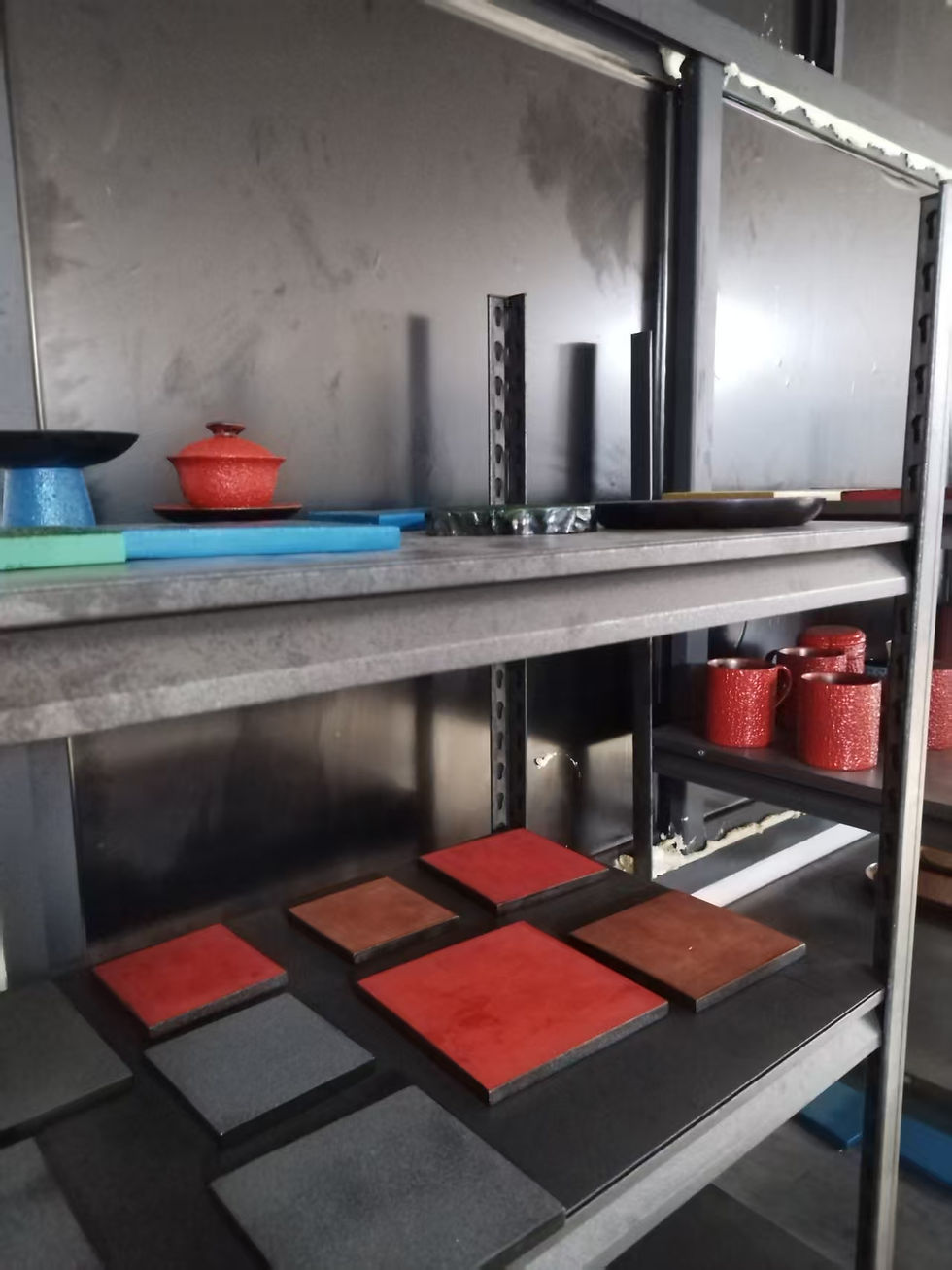
Inside the curing chamber (Yincang). Each layer of natural lacquer requires dedicated time in a humidity- and temperature-controlled room to cure slowly and build its signature depth.
The lustrous surface of a finished piece is never just "a coat of paint." It is the physical accumulation of time, meticulous labor, and endless cycles of transformation.
To appreciate Chinese lacquer art, one must first appreciate raw lacquer—because the beauty we admire on the surface is simply the final chapter of a story that began with a single drop from a tree.
Curious to see how raw lacquer transforms into finished art? Explore our handcrafted lacquerware collection →


Comments