
DESIGN PROCESS
Phase 1:
THE FOUNDATION

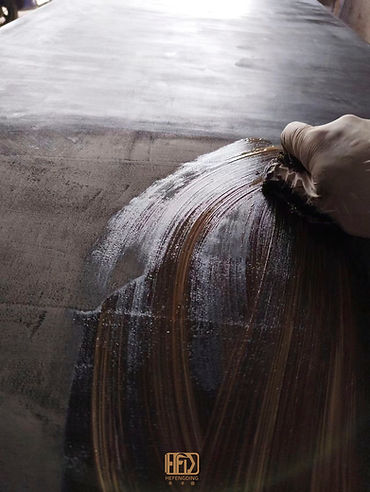
Every piece begins its life as a meticulously hand-carved wooden core, most often shaped from premium Burmese rosewood or dense red sandalwood. To seal and protect this canvas, artisans manually rub raw, natural lacquer deep into the wood's grain.
For our larger vessels and furniture, this is followed by the ancient Pi Ma Gua Hui technique—a rigorous structural foundation where coarse, medium, and fine linen are layered and seamlessly bound with mineral ash. This preparation helps strengthen the foundation and improve its stability and durability.


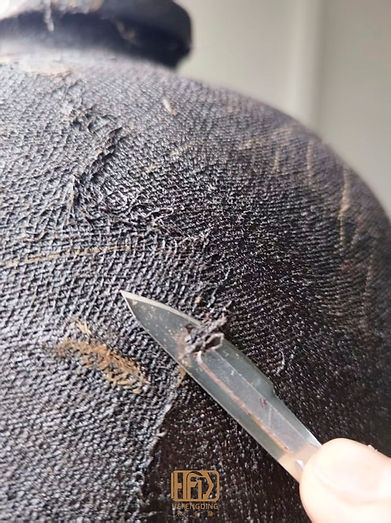
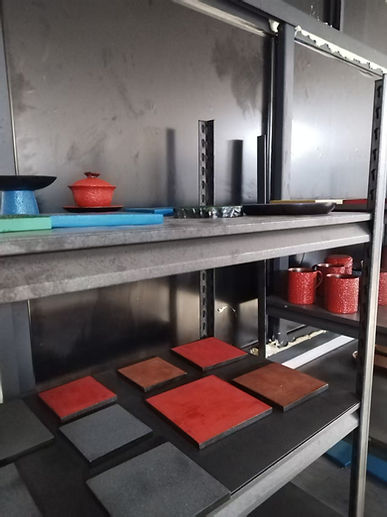
Unlike synthetic coatings that dry in days, raw natural lacquer must be cured in a climate-controlled, lightless room where humidity is strictly maintained between 70% and 80%. The foundation is left to cure before the next stage begins. In our workshop, a hemp-and-ash foundation (披麻挂灰) takes more than three months, while an ash-only foundation (挂灰) takes around two months. This agonizingly slow process allows the colors to deepen into a pure, unclouded state, guaranteeing a finish that will endure for generations.
PHASE 2:
THE DIVERGENCE
Once the foundation has cured, the path splits into our two signature techniques: rhino skin lacquer and flowing gold lacquer.
犀皮漆
Rhino Skin Lacquer (Xipi)
The design methodology of rhino skin lacquer draws inspiration directly from the profound order of nature. To us, Xipi lacquer has the quiet dignity of a gentleman—substantial, composed, and understated. The continuous patterns reflect rivers flowing across the earth or clouds drifting through the sky. Artisans do not paint this aesthetic. They grow it through the deliberate accumulation of history.
At HFDlacquerware, we create Xipi lacquer in two series: Chong and Yi.
崇系列
Chong Series
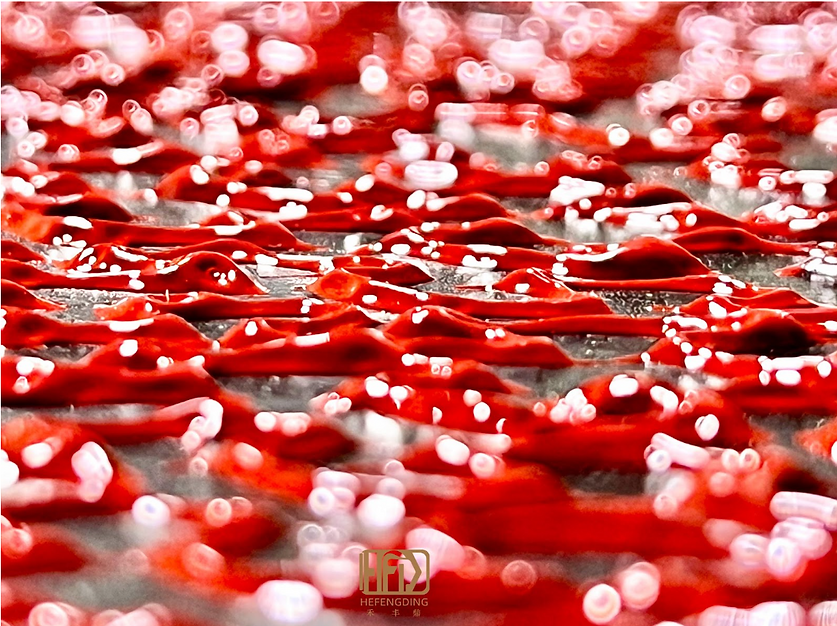
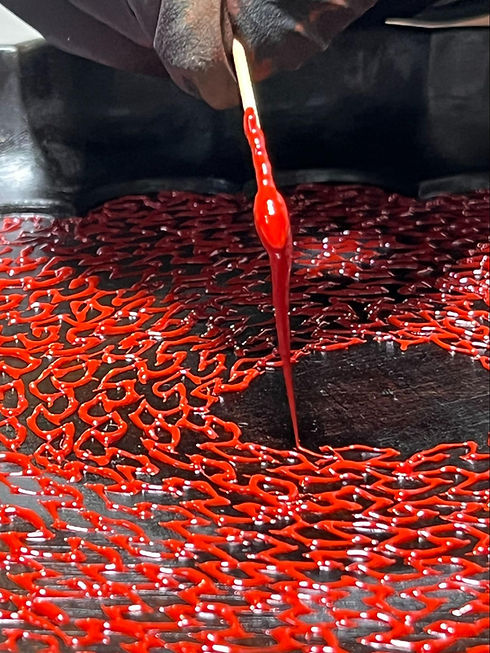
The process begins with Da Nian (打埝)—building lacquer mounds across the surface of the vessel. Colored lacquer is mixed thoroughly with natural egg white, then carefully placed mound by mound with a fine bamboo tool.
Each mound is individually formed, varying in height and shape while connecting continuously across the surface.
After mounding, the piece is placed in a dedicated curing room with controlled temperature and humidity. The higher buildup used in the Chong Series requires at least three months to cure, and in some cases may take up to a year. It must cure fully before further layers of lacquer are applied.
Once cured, layers of lacquer are applied over the buildup until the surface is gradually brought level with the raised foundation.
Each coat must fully cure before the next can be applied, typically requiring seven to fifteen days. Lighter colors, such as ivory white and pale blue, can require at least fifteen days and sometimes as long as twenty days to cure completely.
Layer by layer, the lacquer slowly covers the original buildup.
The texture is there, but no longer visible.
夷系列
Yi Series
Yi follows the same fundamental principle of Da Nian, but with a lower buildup.
After mounding, the piece is placed in a dedicated curing room with controlled temperature and humidity. The lower buildup used in the Yi Series typically takes one to two months to cure. It must cure fully before further layers of lacquer are applied.
The artisan then applies layer after layer of lacquer until the surface reaches the level of the underlying buildup. The Yi Series typically has around 10 layers of lacquer and generally no more than 15.
Each layer must cure completely before the next is applied, typically taking seven to fifteen days. Lighter colors, such as ivory white and pale blue, may require at least fifteen days and sometimes up to twenty days.
With every layer, the hidden landscape becomes deeper.
By the time the surface is ready for sanding, nothing of the original buildup can be seen.
流金
Liu Jin (Flowing Gold Lacquerware)
The Methodology of Fluidity
The design methodology for Liujin takes direct inspiration from the unpredictable beauty of a sudden downpour. It channels the refined Chinese pastime of burning incense to quietly listen to the rain. Artisans capture a fleeting and fluid moment in gold-toned lacquer. Each pattern emerges from the artisan’s hand and the movement of gold-toned lacquer—sometimes spreading in droplets, sometimes flowing in long trails across the surface.


The Flawless Canvas
Flowing gold reverses the usual order of lacquer work. Rhino skin lacquer builds its texture first, at the very start of the process. For flowing gold, the artisan first builds a perfectly flat foundation of ten layers of raw lacquer, curing each layer for 10 to 15 days and sanding the surface until it is completely flawless. The decoration comes only at the very end.
Flowing Gold
Once the lacquer foundation has cured and been sanded smooth, the artisan dips a brush into gold-toned lacquer and gently taps the brush handle by hand. Droplets fall onto the surface of the piece and spread outward, forming patterns that resemble raindrops rippling across still water. The artisan guides where the droplets land, while their size, spacing, and spread give each piece its own distinctive pattern.


The Enduring Radiance
The final piece stands as a permanent testament to patience. Up close, the organic golden paths flow seamlessly over the dark lacquer. We transform raw materials into a timeless heirloom. This striking visual contrast proves that true luxury demands absolute patience.
冰裂纹
Also From Our Workshop:
Ice-Crackle Lacquer (Binglie)
The Methodology of Imperfection
Our work centers on two signature techniques, rhino skin lacquer and flowing gold lacquer. We also make ice-crackle lacquer, mostly for smaller everyday pieces and crafts such as earrings and mugs. The finish takes its inspiration from the moment ice breaks across a frozen surface: an instant that looks chaotic, yet carries its own natural rhythm.

The Organic Fracture
The Ice-Crackle technique also demands a completely flawless 10-layer lacquer foundation. Chemistry triggers the artistry rather than mechanical carving. The artisan uses specialized brushes to apply a coat of natural egg white over the semi-dry lacquer surface. As the egg white dries in the climate-controlled chamber, the resulting tension organically fractures the surface. This reaction violently pulls the top layer apart to form a delicate and interlocking network of cracks.

The Gilding and Suspension
While these deep crevices remain exposed, artisans brush dry brilliant gold powder generously across the surface. The gold naturally settles into the fractured depths. Artisans carefully sweep the excess powder away to leave sharp veins of gold suspended in the dark lacquer.
Finally, a clear lacquer coating is applied, with its thickness adjusted to achieve the desired effect: a thicker coating for a darker, more subdued appearance, or a thinner coating for a brighter appearance.

phase 3:
EXCAVATION & AWAKENING


THE EXCAVATION
After the final coatings cure entirely, the vessel enters the most unforgiving stage of its creation. Artisans must literally excavate the submerged patterns from the dark lacquer. They begin with a rigorous coarse sanding using 350-grit and 600-grit abrasives. This violent step shears away the heavy top layers. The artisan must cut exactly deep enough to break the surface and expose the raw shapes of the hidden rings, marbled vines, or golden fractures without erasing the delicate work beneath.
The Refinement
Once the raw pattern emerges, the artisan transitions to an exhaustive precision water-sanding regimen. They meticulously progress through four stages of increasingly fine abrasives. They climb from 2000-grit all the way to an ultra-fine 7000-grit polish. This microscopic cross-sectioning levels the surface perfectly flush. It removes all remaining scratches and transforms the chaotic excavated texture into a seamlessly smooth canvas.


The Awakening
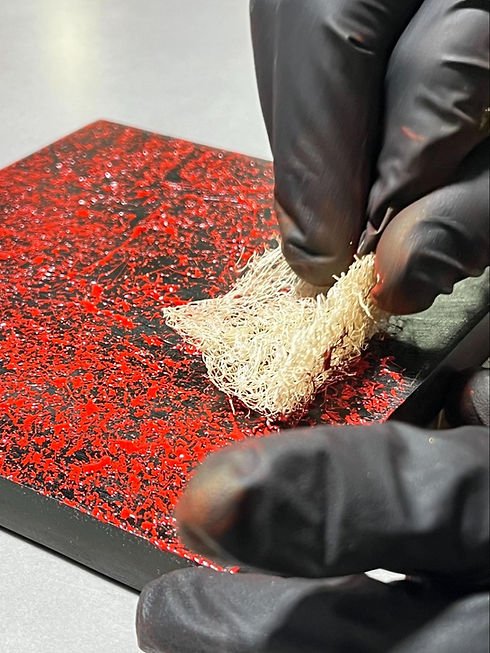
Kaiqing and tuiguang (揩清推光) form a connected finishing process. First, the artisan uses a special cotton pad dipped in raw lacquer to lightly wipe the surface, then wipes it clean with another special cotton pad. After the lacquer has cured, the surface is hand-polished using polishing powders that progress from fine to extremely fine.
This wiping, curing, and polishing cycle is repeated five to seven times, or more as needed. Gradually, the surface becomes smooth and lustrous, revealing flowing patterns beneath a warm, subtle sheen. The depth comes from the lacquer and the repeated hand finishing, giving the piece a natural, restrained radiance.