

Types of Chinese Lacquerware
TYPES OF LACQUERWARE


犀皮漆
RHINO SKIN LACQUER (XIPI)
A perfectly smooth surface defined by intricate, concentric rings—a texture forged by layered time, flowing like rivers across the earth and clouds across the sky.
THE CRAFT
The process begins by building a raised, three-dimensional texture onto the vessel. This groundwork must cure in a dark, climate-controlled room for several months, and sometimes up to a full year. Once it has fully hardened, layer after layer of contrasting raw lacquer is applied over it: 25 or more coats for the Chong Series, and typically no more than 15 for the Yi Series. Each coat takes seven to twenty days to cure before the next can go on.
Rhino Skin Lacquer
THE REVEAL


崇系列
Chong Series
The hidden pattern begins to emerge only through careful hand-sanding. The artisan gradually sands through the layers of lacquer until the surface is completely level. As the upper layers are removed, the cross-sections of the buried buildup appear, revealing lines, shapes, and colors that have been hidden beneath the surface.
The continuous patterns resemble terraced fields seen from high above—layered, connected, and quietly ordered. They can also resemble rivers moving across the earth, or clouds traveling through the sky. The layers evoke the growth rings of an ancient tree, each carrying the trace of time.
The finished surface is perfectly smooth. Its depth does not come from a rough or raised surface, but from the layers revealed within it. Quiet, substantial, and restrained—like a gentleman, entirely its own.
夷系列
Yi Series
The revealing begins with coarse sanding, gradually bringing the surface level and exposing the hidden layers beneath. The artisan then moves through successive stages of fine sanding, refining the surface until it becomes perfectly smooth. With each stage, more of the buried layers are revealed.
What emerges is a pattern that flows continuously across the vessel, like a river moving from one end to the other without a visible beginning or end. At times, it recalls the vast white surface of the Arctic Ocean, marked by delicate fractures.
The surface is smooth to the touch, yet the pattern carries remarkable depth. What moves across it is more than texture. It is movement, vitality, and the trace of life.

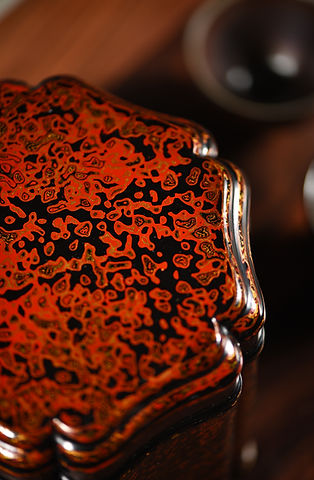

流金
FLOWING GOLD LACQUER (LIU JIN)
A deep, dark lacquer surface where drops of gold lacquer spread like raindrops rippling across a still lake. No two patterns are ever the same.
The Craft
Flowing gold begins with a perfectly flat foundation: ten layers of raw lacquer, each cured and sanded smooth. Gold lacquer is then applied so that it falls like rain. Because it is raw lacquer, each drop bursts open on contact and spreads outward, forming ripples that cannot be planned or repeated. Our standard pieces use gold-toned mineral powder; real gold powder is available on custom orders.
THE REVEAL
After curing, the surface is polished entirely by hand (kaiqing tuiguang, 揩清推光) to a soft, deep luster. The finished piece sets bright gold against dark lacquer, catching the light differently from every angle.