
How to Choose a Good Pair of Chinese Lacquer Chopsticks

A good pair of lacquer chopsticks should feel comfortable in your hand, suit the way you eat, and hold up to everyday use with proper care. But when shopping online, it can be difficult to judge the materials and workmanship from photographs alone.
The tips below come from our years of making lacquer chopsticks at HFDlacquerware. Whether you’re buying for yourself or choosing a gift, I hope they help you know what to look for—and what to ask before buying.

1. Ask What Finish Is Used on the Chopsticks
The word “lacquer” can refer to different finishes, so start by asking the maker what they use.
Natural raw lacquer comes from the sap of the lacquer tree. It is the material we use at HFDlacquerware, applied in successive layers and given time to cure between stages. On our chopsticks, flowing gold or rhino skin lacquer decorates the upper handles, while the remaining sections are finished in plain black natural lacquer.
Other chopsticks may use synthetic finishes, whose properties vary according to their formulation and application.
Color, shine, and pattern can help you appreciate a finish, but photographs alone cannot reliably tell you what it is made from. Look for a clear description of the materials, confirmation that the finished chopsticks are intended for food use, and specific care instructions.
If that information is missing, ask the seller before buying. We discuss these differences in more detail in our Journal article, Is Lacquerware Food Safe? Natural Raw Lacquer vs. Synthetic Finishes.

2. Check the Wooden Body
If lacquer is the coat, wood is the skeleton. The wooden body affects the weight, balance, and feel of the chopsticks. The type of wood matters, but so do its preparation and the quality of the finished pair.
Our chopsticks are made of ebony. We choose it for its fine grain, density, and satisfying weight in the hand.
When choosing a pair, look for straight, evenly shaped chopsticks, and consider whether you prefer a lighter or more substantial feel. Both chopsticks should be consistent in length and thickness, with tips that meet evenly.

3. Check the Length and Shape
Length is a useful starting point, but comfort is personal. For adult dining chopsticks, 23–27 cm—roughly 9–10.5 inches—is a range worth considering. The best choice depends on your hands, preferences, and how you use them. Ours are 25 cm, just under 10 inches.
Our chopsticks follow a traditional Chinese shape: square at the top and round toward the tips. The square upper section helps keep them from rolling on the table, while the rounded tips feel smooth in the mouth.
We make a few refinements to this familiar form. The tips have a matte finish to help with grip when picking up foods such as tofu or sweet rice balls. The upper section has softly rounded corners, giving the fingers a gentler surface to hold.
For certain custom designs, where the two chopsticks need to sit closely together to display a complete pattern, we use a fully square upper section instead. Rounded corners leave a small gap between the pair, which can interrupt the design.
In both versions, we pay attention to how the finished chopsticks feel in the hand.

4. Choose the Technique and Pattern
Once you understand the materials and shape, you can choose the colors and patterns you enjoy. Our lacquer chopsticks come in two main techniques.
Rhino Skin Lacquer: The Yi Series
Rhino skin lacquer (Xipi, 犀皮漆) gets its pattern from raised texture and layers of colored lacquer.
For our Yi series, we use a loofah to dab low mounds onto the surface. These are covered with successive layers of colored lacquer, then sanded to reveal the colors beneath.
Small variations in the raised texture, layers, and sanding give each pair its own pattern. Even when we use the same color combination, the result is never an exact repeat.

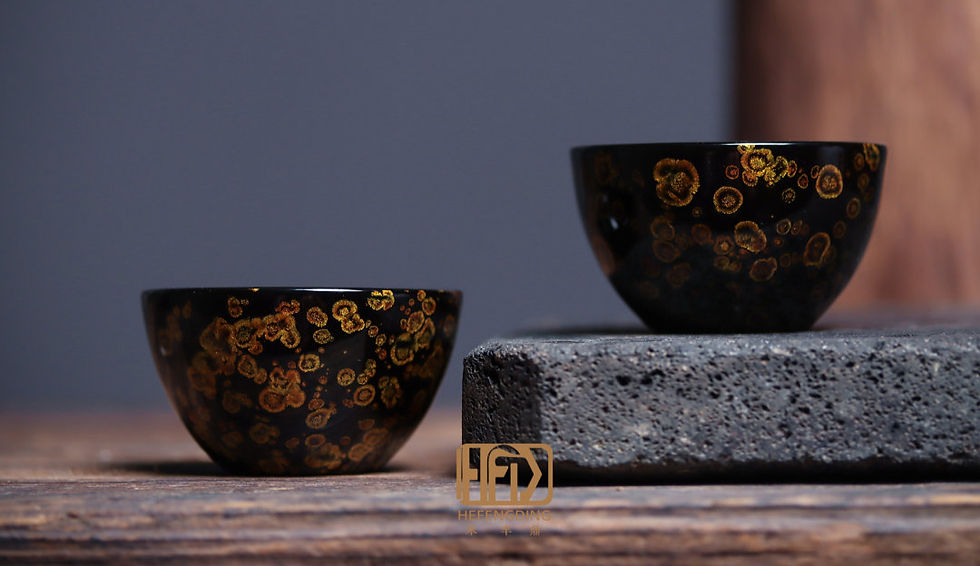
Flowing gold lacquer (Liu Jin, 流金) brings gold-toned patterns across a black lacquer surface. Depending on how the lacquer is applied, the gold may appear as scattered droplets, flowing lines, or larger areas.
Our standard pieces use gold-toned powder. Real gold is also available for custom orders.
When choosing either technique, ask how the pattern is made. Close-up photographs and images of the making process can help you understand the work and see the differences between individual pairs.

5. Look Closely at the Finishing Details
Materials are only part of a good pair. The finishing details matter too.
Feel the surface. It should feel comfortable and evenly finished, without rough edges or obvious defects.
Compare the pair. Check that both chopsticks are straight and consistent in length and thickness.
Look at the finish up close. Clear photographs of the tips, upper ends, and lacquer surface are more useful than a single distant image.
Notice any strong odor. If the chopsticks have a strong or persistent smell, ask the seller before using them. A lack of odor alone does not confirm the material or its suitability for food use.
If you are buying online, look for a seller who explains the materials, shows the details, and is willing to answer questions.

Do You Need Chopstick Rests?
Chopstick rests give you somewhere to put your chopsticks between bites, keeping the tips off the table.
Both our rhino skin Yi series chopsticks and our flowing gold chopsticks are available as a single pair or as a set with chopstick rests. The Yi series comes with black lacquer rests, while the flowing gold rests are made to complement the chopsticks’ pattern.
If you’re choosing a gift, a set offers a complete arrangement for the table. Every pair comes in a gift box, whether purchased on its own or with rests.

Frequently Asked Questions
What is the difference between Chinese and Japanese chopsticks?
Chinese dining chopsticks are generally longer and have blunter tips, while Japanese dining chopsticks are often shorter with more pointed tips. Shapes vary by maker and intended use, so these are common tendencies rather than fixed rules. Our Chinese lacquer chopsticks are 25 cm long, with softly rounded tips and a matte finish to help grip food.
How long do lacquer chopsticks last?
A well-made pair can serve you for years with appropriate care. Its lifespan depends on the workmanship, frequency of use, and how it is washed and stored.
Are lacquer chopsticks dishwasher safe?
Our lacquer chopsticks should be washed by hand. Use mild dish soap and a soft cloth or sponge, then rinse and dry them promptly. Avoid prolonged soaking and abrasive scrubbers.
For more guidance, read our Journal article, How to Care for Chinese Lacquerware: Everyday Use and Storage Tips.
Can I order a custom pair?
Yes. We welcome requests for custom colors and designs through our Custom Orders page.
Starting entirely from scratch takes around six months for flowing gold lacquer chopsticks and around a year for rhino skin lacquer chopsticks in the Yi Series. However, we usually prepare chopstick bodies in advance, completing the early reinforcement stages before a custom request comes in. When a suitable prepared base is available, a custom pair can usually be completed in approximately three to four months.
Timing depends on the design, technique, and availability of prepared bases. We’ll confirm the expected timeline with you before you place your custom order.

Choose a Pair You’ll Enjoy Using
A good pair of lacquer chopsticks brings together materials, workmanship, and a comfortable shape. The pattern may catch your attention first, but the feel in your hand is what you’ll return to at each meal.
Take time to look at the details, ask about the finish, and choose colors you enjoy.
— Zoe of HFDlacquerware (禾丰鼎)


Comments