
How Traditional Chinese Lacquerware Is Made

Traditional Chinese lacquerware is made by applying many thin coats of natural tree sap over a wood, porcelain, or hemp-cloth body, letting each coat cure in a warm, humid room for one to two weeks, and polishing the surface by hand. A single piece takes anywhere from several months to a few years.
A piece of traditional Chinese lacquerware is built up by hand, one coat of natural lacquer at a time: applied, cured, and sanded, again and again. Lacquerware has been made in China for more than 7,000 years, and the core method has barely changed. Here are the seven steps that take a piece from a bare form to a finished work.

The Seven Steps of Making Lacquerware
Selecting the lacquer: Raw lacquer (大漆, da qi) is the natural sap that flows from the lacquer tree (Toxicodendron vernicifluum) when its bark is cut. It is the same tree that gives Japanese urushi. Once cured, it is hard, heat-resistant, waterproof, and corrosion-resistant. Our raw lacquer comes from a trusted supplier we have worked with for many years.

Raw lacquer (da qi), the natural sap of the lacquer tree. Making the body: Lacquer cannot hold a shape on its own, so it must be applied over a body, or core. Common bodies include wood, porcelain, and bodiless lacquer (脱胎, tuotai, also called 夹纻, jiazhu), made by layering hemp cloth and lacquer paste over a mold, then removing the mold once the layers have cured.

Hardwood blanks waiting to be shaped into lacquerware bodies. Building the foundation: The body first receives two coats of lacquer paste, then three rounds of hemp cloth and paste. We usually make the paste from fired-clay powder (瓦灰) mixed with raw lacquer; for the hemp layers we also add rice paste for stronger adhesion and a sturdier piece. The cloth varies too: medium-coarse or coarse hemp for small pieces such as jars, and the coarsest hemp for large pieces such as furniture. This step is invisible in the finished work, yet it determines how many years a piece will last.

Coarse hemp cloth used to reinforce the foundation of large pieces such as furniture. Decorating: For rhino skin lacquer (Xipi, 犀皮漆), we first build up raised ridges (打埝, da nian), then apply lacquer over them. The ridges can be high or low, continuous or broken. Before any lacquer goes on, the ridges must cure. A black ridge base tall enough to take more than 20 coats usually needs three to four months; red or light-colored ridges take longer, and very high ones may not cure fully even in a year. A red-ridge plum vase (meiping) we are making now is still not fully cured after a year. Once the ridges have cured, each coat of lacquer on top needs at least a week to cure, and light colors such as gold-toned lacquer need at least ten days. To be safe, we let every coat cure for 15 days.
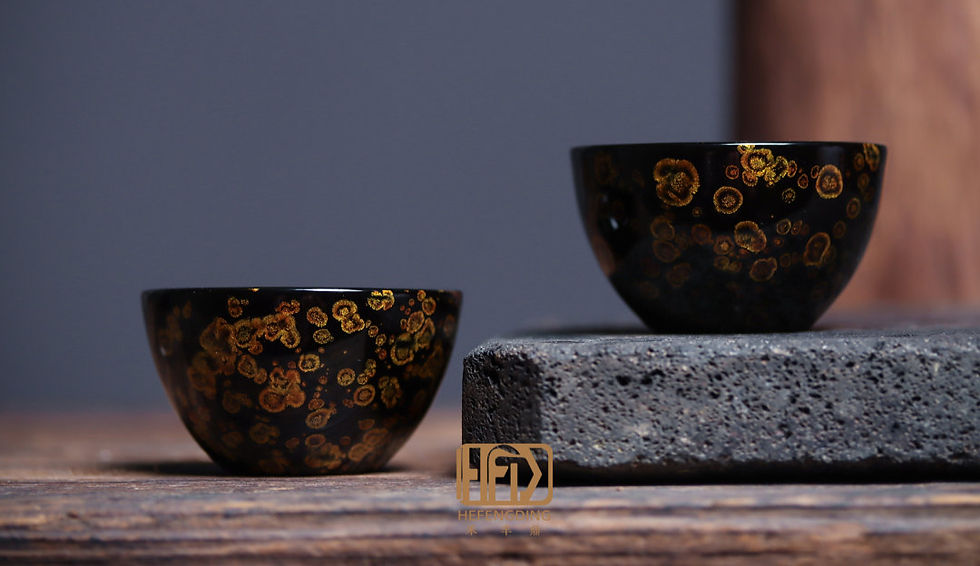
For flowing gold lacquer (Liu Jin, 流金), we first apply about ten coats of lacquer, then add gold-toned powder. It can be applied in different ways: small drops, large drops, a light scatter, or broad patches.

Raised red ridges on a black base, the first stage of rhino skin lacquer. Curing: Every step needs time to cure. Raw lacquer only cures slowly in a warm, humid curing room (荫房, yin fang), kept at 77–86°F (25–30°C) and 75–85% humidity. Each coat must cure completely and be sanded before the next one goes on. The curing room gets no sunlight and the lights stay off, which helps keep the colors pure.

Pieces curing on the shelves of our curing room. Sanding: Rhino skin lacquer is sanded after all the coats are finished, first coarse sanding with 350- and 600-grit paper, then fine sanding with 2000-, 3000-, 5000-, and 7000-grit paper. Flowing gold lacquer is sanded before the gold is applied: after every two or three coats, the surface is sanded with 2000-grit paper, and once all the coats are on, it is sanded through the finer grits up to 7000.

Fine sanding a flowing gold lacquer piece with 2000-grit sandpaper. Wiping and hand polishing: We alternate wiping (揩清, kai qing), in which a very thin layer of clear refined lacquer (熟漆, shu qi) is rubbed on and wiped back off, with hand polishing (推光, tui guang), repeating the cycle five to eight times. For polishing, we work the surface with the palm of the hand and polishing powder in three grades (fine, extra fine, and ultra fine), using each grade once or twice, sometimes more. The result is a soft, warm luster that seems to glow from within.
For the full details of each step, see our Design Process page.

Decorative Techniques
With this foundation in place, the craftsperson gives each piece its character through decoration. HFDlacquerware (禾丰鼎) focuses on two techniques:
Rhino skin lacquer: Anywhere from ten to dozens of layers of colored lacquer are stacked, then sanded back to reveal flowing, cloud-like patterns. No two pieces are alike. Explore the Rhino Skin series.
Flowing gold lacquer: Gold-toned powder falls across the surface like raindrops and flows naturally. Custom pieces can be made with real gold powder.Explore the Flowing Gold series.

Flowing gold lacquer chopsticks with a matching dish.
Frequently Asked Questions
Can lacquerware hold hot drinks and food?
Yes. Once fully cured, natural lacquer is heat-resistant and waterproof, so our lacquer cups and bowls can safely hold hot tea, hot water, and food.
Will lacquerware cause an allergic reaction?
Very unlikely. Uncured raw lacquer can irritate the skin, which is exactly why every coat is left to cure completely in the curing room. Once fully cured, the lacquer is hard and stable, and it is safe for everyday use.
Why is handmade lacquerware so expensive?
There are two reasons: the material and the time. Natural raw lacquer is a costly material. And because it comes from nature, it follows nature's pace. It cannot be rushed or forced dry; each coat has to cure slowly in the curing room, so a single piece takes months or even years to finish.
How do I care for lacquerware?
Everyday care is simple. Wash it by hand with a soft cotton cloth and regular dish soap, then dry it right away. Never use steel wool or abrasive scrubbers, and keep lacquerware out of the dishwasher, microwave, and oven.

Closing Thoughts
HFDlacquerware (禾丰鼎) lacquerware comes from a family workshop in Xianyou, Fujian, where every piece is made by members of our family. Each coat must cure completely in the curing room before the next step, and there is no way to rush it, so a single piece takes anywhere from several months to a few years.
When you hold a piece of lacquerware, you are holding a drop of sap from the lacquer tree, countless days and nights in the curing room, and the patience of many hands.
Written by Zoe of HFDlacquerware (禾丰鼎). Based in the United States, Zoe works with her family, who make every piece by hand in their workshop in Xianyou, Fujian.


Comments